




Being able to multiply without a calculator is an essential skill in maths, and it is developed gradually from KS2 through to GCSE. While younger students are often taught a structured method, older students are expected to choose whichever method is most efficient for the question.
Column multiplication at KS2
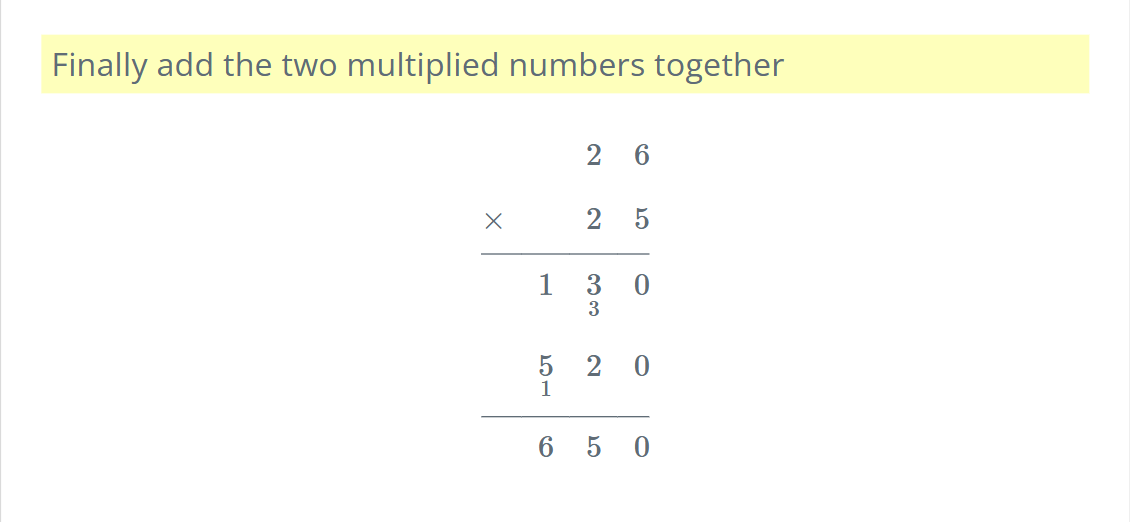
At Key Stage 2, students are typically taught the column method (also known as long multiplication). This method provides a clear, step-by-step structure that helps learners keep track of place value.
For example:
  23
× 14
-----
  92   (23 × 4)
230    (23 × 10)
-----
322
This approach is important because it builds understanding of place value and ensures accuracy when working with larger numbers.
Mental and informal methods
As students progress, they are also introduced to more flexible strategies that support mental arithmetic, such as:
- Partitioning
- Breaking numbers into tens and units
- Example: 23 × 14 = (23 × 10) + (23 × 4)
- Grid method (area model)
- A visual method that links multiplication to areas of rectangles
- Helps bridge the gap between informal strategies and formal column multiplication
These methods encourage number sense and help students understand why multiplication works, not just how to perform it.
At key stage 3: choosing the best method
By the time students reach key stage 3, they are no longer restricted to a single method. Instead, they are expected to choose the most efficient approach depending on the question.
For example:
- For simple calculations, mental methods may be fastest.
- For larger numbers, column multiplication is often reliable.
- For algebraic expressions, methods like distribution (expanding brackets) are essential.
Secondary school teachers are more interested in accuracy and clear working than the specific method used.
Why flexibility matters
Being able to switch between methods is a key skill in mathematics. It shows strong number sense and helps reduce mistakes under exam pressure. Students who understand multiple approaches are also better equipped to check their answers and spot errors.